The night before Hill Day, I called my mom from the hotel and cried.
I’d spent the day in training and the evening at dinner with the foundation’s founders, a few survivors, a father and the paramedic who’d worked his son’s last call. Everyone there had come with someone. I had come alone. I told my mom I wished she were here.
We were there for Ellie’s Law.
Ellie Helton was fourteen. She woke up one morning with a terrible headache. A plum-sized aneurysm on her brain stem had ruptured. She’d had headaches and blurred vision in the weeks leading up to this rupture. Doctors couldn’t identify the cause.
The bill is named for her, and for a handful of other women and girls who didn’t get the chance I got.
The federal government spends three dollars and two cents a year, per person afflicted, studying the thing that nearly killed me. Aneurysms show up more often in women than in men. Roughly half of the ruptures are fatal. Of those that are not the majority are left with some form of permanent neurological defect.
I am, statistically, a coin that landed on its edge.
The survivors all said a version of the same sentence, like a password.
I was too stubborn to die.
They said it lightly, the way you’d mention a quirk. Apparently their doctors said it too.
I’d said something similar myself. I told Patrick I knew I was going to be okay, I was determined not to die.
I don’t remember much from the day my aneurysm ruptured. But I do remember this: a nurse wheeling me toward the OR doors, asking if I was nervous.
“No,” I told her. “I can do this.”
It’s the same sentence every one of those women, all the survivors I met this year were women, was still saying about herself, years later.
Among the others there was a father who had lost his son. His wife couldn’t come — still too hard, he said, and left it at that. At dinner, I asked him about his son. The paramedic sat beside him all evening; the two of them have since started a foundation together. He told me how little he’d understood about aneurysms before that call. How little any paramedic is taught about them, even though they’re the ones who get sent. I’d always assumed the people who arrive in the ambulance know exactly what is happening inside your skull. A lot of them are guessing too.
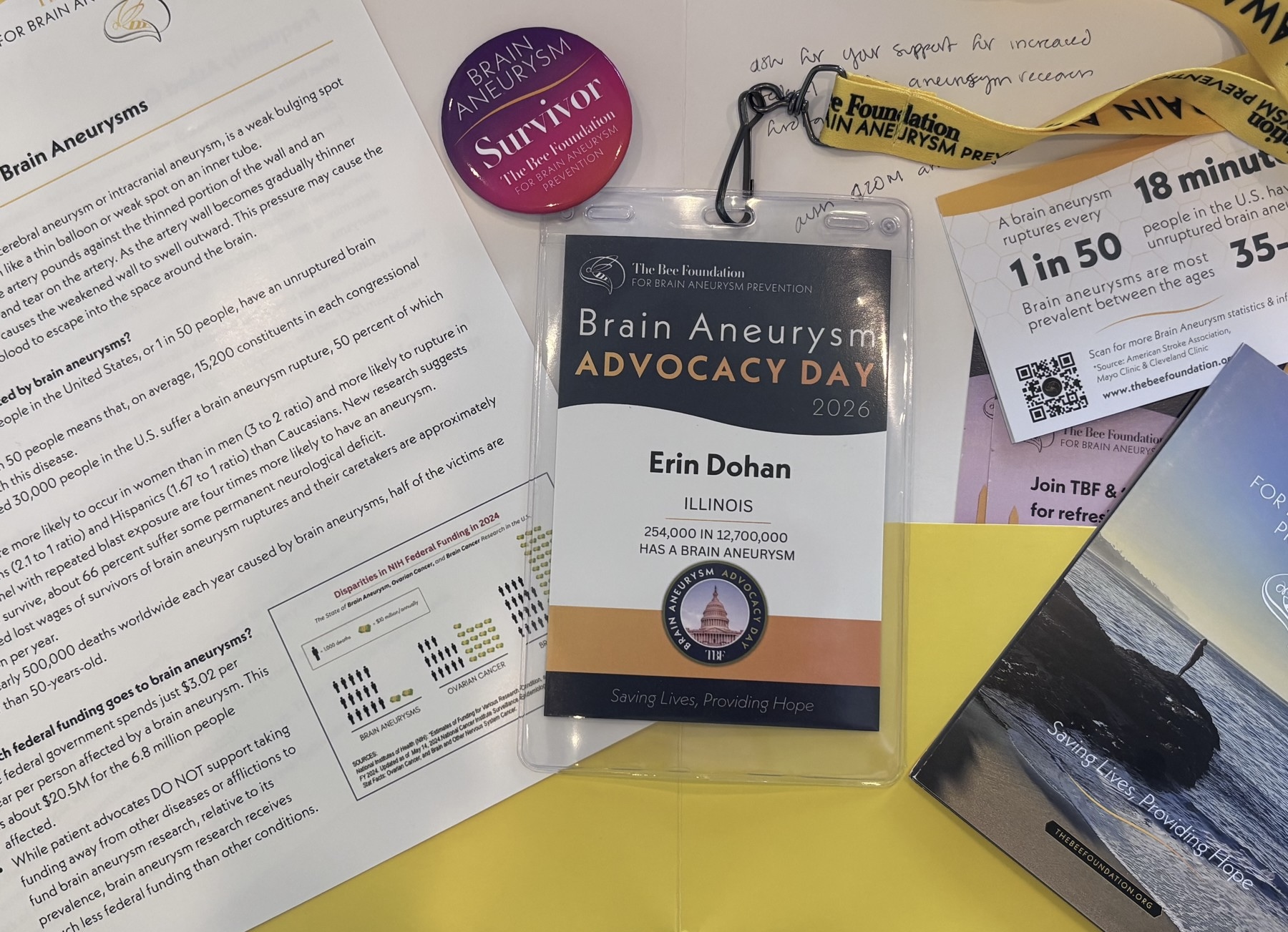
The next morning I put on my badge and my survivor pin and headed to the Hill.
Paula, the other survivor in my group, and I didn’t get far before we had to stop walking. The marble hallway tilted — the way it does for both of us now — and we stood against the cold wall until it held still. Two aneurysm survivors, dizzy in a congressional office building. We laughed, and she confirmed I was able to take my meds that I struggled to get out of my bag.
There’s a specific laugh you only share with someone whose brain also tried to kill her.
The staffers we met with were mostly women, most of them younger than me. I told them I was twenty-seven when mine ruptured. I told them the rare part wasn’t the aneurysm; one in fifty people are walking around with one they’ve never been told about. The rare part was getting to sit in their office and talk about it.
Another survivor at dinner had told me her husband has never once been able to talk about her aneurysm. Not in all these years. When I got home, I made Patrick talk about mine. He opened up a little, more than he ever had.
The day after Hill Day, my mom called to check on me. I was calmer by then. Steadier than the night I’d cried into the phone. I told her about my day on the Hill. Then she told me she’s still afraid of how close it came, how close they were to losing me. The night I cried to her, she and my dad had talked about how lucky they were. She’d been waiting, I think, until I was steady enough to hear it.
The whole two days, I kept asking myself why I felt like a fraud at that table.
There were these other people, survivors and supporters, around that table. One of them finished a triathlon and she now holds a world record for first person with a brain aneurysm to do so. One does Hyrox now, competitively, for fun, after her brain did to her what mine did to me. The father turned the worst day of his life into a foundation with the man who tried to save his son.
They didn’t just survive the thing. They went and did something loud with the time.
I wish my mom could have been there. I know she’ll be there next year.
I wish everyone who didn’t get to stay could have been there too. I know their people will keep coming in their place. Saying the names on purpose, the way that father said his son’s.
And for the rest of us, the ones who were too stubborn to die:
Stay stubborn.